


History and Location
Pozzallo: Born on the sea, guardian of history, heart of the Mediterranean. Welcome to the city where the horizon never ends.
The Origins (1969)
The municipal library was established with municipal council resolution n. 138 of 27 March 1969, adopted by the Mayor Amore Antonino and the Councilors Giardina Antonino, Galfo Vincenzo, Assenza Vincenzo and the Council Enrichetta. The aforementioned resolution was subsequently ratified by the municipal council, with act no. 112 in the session of 7 June 1969, by the following 18 municipal councilors present (out of 30) who voted unanimously in favour: Amore Antonino, Sulsenti Salvatore, Modica Corrado, Rogasi Salvatore, Salonia Carmelo, Giardina Antonino, Giunta Enrichetta, Susino Natalizio, Vindigni Francesco, Galfo Vincenzo, Sangiorgio Francesco, Zocco Pisana Giuseppe, Giunta Antonino, Ricca Michele, Livia Antonino, Cristina Giovanni, Assenza Vincenzo, Salvino Giovanni.
With subsequent resolution no. 621 of 20 November 1970, adopted by the Mayor Ferruccio Giardina and the Councilors Sulsenti Salvatore, Galfo Vincenzo, Vindigni Francesco and Susino Natalizio, the municipal council implemented the previous institution of 1969, identifying the premises to be used as the library headquarters and attributing, in an honorary capacity, the title of Director to the municipal councilor prof. Sigona Attilio and that of assistant librarian to Miss Ruggieri Nunzia, a clerk.
The ratification of the aforementioned resolution by the City Council took place in the session of 30 October 1972, with act no. 38, with 13 votes in favour, 10 against, 2 blank ballots.
The regulation governing the activity of the Library was approved, under the pressure of the then director Attlio Sigona, with municipal council resolution no. 576 of 30 August 1971, adopted by the Mayor Sulsenti Salvatore and the Councilors Giardina Antonino, Galfo Vincenzo and Vindigni Francesco. The ratification of the City Council took place with act no. 39 in the session of 30 October 1972, with 16 votes in favor and 1 against.
Recently, on a proposal promoted by the administration of the mayor Giuseppe Sulsenti with resolution of the municipal council n. 207 of 28 October 2011, the City Council with council resolution no. 72 of 28 December 2011 approved the new Library regulations, which implemented the new regulations as well as the practices established over time at the request of users and those introduced by new technologies or opportunities aimed at improving the Service,
The Library was solemnly inaugurated on 4 November 1973 in the restored location of the former market in Piazza Cesare Battisti, in the presence of the highest city authorities including the Mayor of the time Vincenzo Galfo, the Hon. Natalino Amodeo, the Archpriest Emanuele Giannone, who donated a Bible. The ribbon cutting was entrusted to Mayor Galfo's wife, teacher Maria Ombrellino.
The first transfer to a more worthy location, i.e. to the premises of Palazzo Giunta-Musso, occurred in the 1980s. It remained in this location until 3 October 2009, when the new prestigious headquarters of Villa Tedeschi was inaugurated, in the presence of the heirs of the Marquis Tedeschi and with an important success of presence.
To date, the book heritage consists of over 27,000 volumes, including particularly valuable examples.
The Library adheres to the Provincial Library System, managed by the Bibliographic Service of the Superintendency of Cultural and Environmental Heritage of Ragusa and an integral part of the Regional Library System (promoted by the Regional Department of Cultural and Environmental Heritage) and the National one (promoted by the Ministry of Cultural and Environmental Heritage).
As part of this project, the computerization of the book catalogue, present online at www.sba.rg.it together with those of the other provincial libraries, is being completed.
The municipal library has today taken on an important new role, both institutional, supporting and encouraging the initiatives it proposes in promoting culture and reading among citizens, and organizing events, encouraging the realization of the many cultural proposals that attract interest and appreciation. In both areas, particular attention is paid to children and young people, for whom specific initiatives are carried out, thanks also to the precious and irreplaceable collaboration of schools.
All this made it possible to record the issue of over a thousand cards to as many users and a considerable increase in readers and visitors who used the services offered.
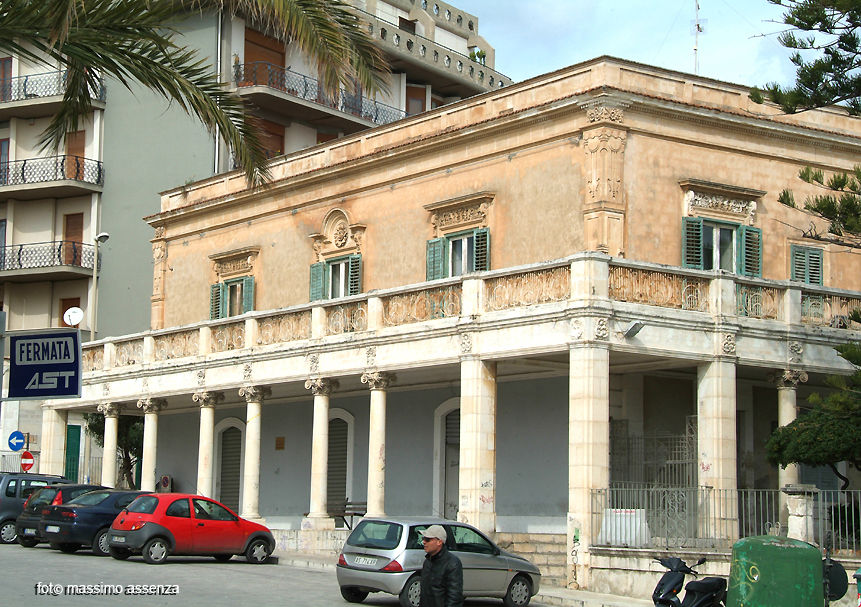

Villa Tedeschi
For the fee of 6 onze per year of ownership and dominion rights, the Count of Modica Lodovico Enriquez Caprera granted, on 10 April 1565 with a deed of the notary Gian Simone Di Giacomo, "the suitable lands of the Scaro seu Puzzallo, aut Centobucari, bordering the trazzera of Sancte Marie Fucalli, vignalibus of Comitini, public road that goes to Turrim Puzzalli, Litore Maris and other borders” to Don Vito Cultrera Restivo, who in turn sold them to the Bonanno family in 1602. On 20 November 1641 Giambattista Bonanno endowed the Scaro estate with his sister Lucia's husband, Antonio Salemi, who on 15 June 1687 donated it to his eldest son, Baron Biagio Salemi. On 16 November 1701 the latter gave the fund as a dowry "to his daughter Donna Francesca in the circumstance of giving her as a husband to Baron Francesco Cuella of Spaccaforno". On 28 October 1717 Baron Francesco Cuella exchanged the Scaro territory with Baroness Anna Lorefice, from whom he had an estate in Modica.
In 1779 the fiefdom came to Don Romualdo Mattia Lorefice Platamone, descendant and heir of Baroness Anna Lorefice, 7th Baron of Mortilla and 1st Marquis dello Scaro, the latter title received on 28 March 1815 for the services rendered to the Crown by his trading house in the Feudo dello Scaro.
He was the organizer of the Pozzallo mill and obtained, in 1811, the decree to build the city of Pozzallo. As Lorefice's fortunes unfolded, the benefactions in the fief multiplied at the same rate. The work of the bricklayers engaged in houses, millstones and warehouses was followed by that of the carpenters and farmers.
The windows were changed, doors, furniture and wardrobes were built for the secretariat, alcoves and wardrobes. They "worked to plant vineyards" and became "running vanelle".
In 1829, upon the death of the Marquis, the title and the fiefdom passed, as per the will of 2 February 1829, to his nephew Giuseppe Polara Lorefice. With a deed of donation dated 29 March 1840, the latter passed title and fiefdom, with the Villa partially completed, to his son Don Giorgio Polara Lorefice, husband of Domenica Tedeschi. In a declaration dated 5 June 1852, Giorgio Polara Lorefice and Domenica Tedeschi signed as follows: "In 1852 the benefits and the boundaries were as follows: Casina with several buildings incomplete with buildings and furniture, with warehouses, horseman's shop, strawman, mill houses, farmhouse houses, tile house with wells in the Bue Marino district, bordering the lands of the heirs of Don Saverio Nicastro, public road, Pantanelli di Pietre Nere, Vaccaro lands, sea water and other boundaries.
Giorgio Lorefice made the following improvements: in the little house he had the vaults built all on the main upper floor. The small quarters on the second floor are more complete, of which only the bases of the steps existed before the donation. Furthermore, the entire upper fourth continent is the kitchen, the dining room, the passageway connecting the dining room, and all the closets and closets attached to the aforementioned fourth, as well as the private staircase used to bring the servants into the kitchen.
Plus all the plaster, stucco and paintings of all sorts on the upper floors. Plus quarter painting and low workshops. Plus the small church, and the beginning of the large church. The garage plus another stable adjacent to the garage with its straw hay and dressing room for the coachman's convenience.
Two lower bedrooms for servants' use.
Another large stable with its straw shed adjacent to the said rooms, and a house of branches adjacent to the said stable, and at the entrance to the staircase that leads to the kitchen. The mandra house and dwelling houses for the men employed in the cultivation. Two porticoes that lead onto the Spaccaforno street.
In the former fiefdom the aforementioned Mr. Don Giorgio had all the walls built from a new plan, both external and those of all the internal divisions that exist in the former fiefdom... which improvements the parties declared to have verified.".
Domenica Tedeschi, during Garibaldi's epic, abandoned her husband for the patriot Francesco Giardina, to whom she later gave birth to a son, but died in childbirth. The Marquis Giorgio Polara, left alone, instructed him to find the most beautiful girl in Pozzallo.
As chance would have it, this was a certain Agata Galazzo, the fourteen-year-old daughter of a large family of sailors, who, although engaged to a young man of the same class, a certain Ferdinando, did not hesitate to go to the palace when faced with the prospect of taking the place of the fugitive marquise.
From this event originates the saying, still in use today in Pozzallo, "Firdinannu, Firdinannu cu ti resi stu malannu ... you arruspigghiasti 'na matina e never found Agatina!".
In 1850, Galazzo gave the Marquis a daughter, Concetta, born illegitimate and legitimized only in 1860 when, due to the death of his wife Tedeschi, Marquis Giorgio was able to marry Galazzo.
The Villa was now in full splendor and Concetta Polara, the Marchesina, having reached marriageable age and having received the title of Marchesa, the lands and the Villa dello Scaro as a dowry, married Michele Rizzone Tedeschi, a rampant politician from Modica, who by will of her maternal grandfather Corrado Tedeschi had placed the surname Tedeschi before her paternal one Rizzone.
Senator Michele Tedeschi further embellished the Villa, where he lived (on 28 October 1960 he was awarded honorary citizenship in Pozzallo); he was elected deputy to the Italian parliament on 20 November 1870 and reconfirmed three times. He passed away peacefully on 14 July 1898 in Villa dello Scaro.
From Baron Romualdo Mattia Lorefice Platamone to Senator Michele Tedeschi, the epic of power in the County of Modica passed in the residence of Scaro di Pozzallo. With a deed of donation dated 18 August 1897, the Tedeschi couple donated the Scaro estate with its stately home, gardens, millstone, press, farmhouses, tile house, warehouses and outbuildings to their younger son Corrado Tedeschi.
Corrado Tedeschi married, on 8 January 1898, the beautiful Rosalia Nocera Aliotta, with whom he had four children: Mimy, Linda, Nino and Bebe. The Marquise's Modican salon was one of the most popular at the time, her receptions were considered among the most splendid and her conversations were considered among the most amiable; she was in fact a cultured woman - she was interested in art, literature, music, theater and sport - and she was a virtuous and charitable woman, who always made admirable use of her wealth by helping, particularly during the First World War, military families, the disabled, widows, war orphans, kindergarten children and the needy in general.
The sudden death of his father, in July of the same year, suddenly put Corrado faced with the new responsibilities of managing the inherited assets, which he faced with common sense thanks also to the help of the accounting administrators who had frequented the Villa for years and looked after the interests of the family and the fund, including Gaetano La Pira, father of Giorgio La Pira.
Widowed on 30 April 1922, he dedicated himself to local political life, also favored by his prestigious surname, to which his father had given great notoriety. With the new fascist rules, the Prefect decided to make use of the right to appoint a Prefectural Commissioner in place of the fallen Mayor: the choice fell on the Marquis Corrado Tedeschi, who willingly accepted, thus becoming the first Podestà of Pozzallo appointed after the advent of the regime, a figure who also combined the functions of the Council, the Council and Government Official.
The "new" Pozzallo owes a lot to his political action: he started the works for the expansion of the Cemetery, those of the aqueduct linked to the Favara spring and the strengthening of the stone pier, to facilitate docking for small sailing ships and fishing boats. Work began on the construction of the large square, now known as Delle Rimembranze, brick-paved, with 46 palm trees on the edges corresponding to the number of Pozzallo soldiers who died in the war, with the bronze War Memorial in the centre, created in 1928 by the Roman sculptor Benedetto D'Amore.
Podestà Tedeschi instead entrusted the projects for the new Town Hall, those of the small square in front and of the Villa Comunale, adorned with an artistic railing, now replaced, to the engineer Giovanni Raimondi, designer of the Gentilizia Chapel of the Villa. The works, carried out by local workers, were completed between the late 1920s and early 1930s, further embellishing our historic center with this architectural complex.
In the 1930s, when the helm of the Municipality had already passed to other Podestà, the Marquis Tedeschi continued to follow the city's events over time, being part of the various Committees created to give greater visibility to the "town of baths".
Once the years of the Second World War had passed, the administrative elections brought Doctor Antonino Giunta to the position of Mayor of Pozzallo in 1952: Marquis Corrado Tedeschi was Councilor until 1956, a year which, for health reasons, marked his retirement from the city's political scene. Furthermore, a reduction in his assets had added to his ailments and by necessity he had to sell a large part of the inherited fiefdoms.
On this occasion he felt the bitterness of seeing the estrangement of people who had been gratified by him, then reciprocating it, in bad luck, with silence and ingratitude. In 1955 he abandoned Villa dello Scaro, now too large for a single person in financial difficulty and too far from the historic center due to age-related ailments, and moved to a much more modest house, in Piazza Mercato, closer to the centre.
After a few days of illness, Marquis Corrado Tedeschi passed away on 27 December 1957, at the age of 80. The noble chapel of the Villa dello Scaro, which after him, known as "u Marchisi", was identified as the "Villa Tedeschi", welcomed his remains alongside those of his ancestors. The Villa was purchased in 1979 by the Municipality and today, after a recent restoration, it is home to the Municipal Library and the adjoining Museum Gallery, as well as a vital cultural centre.
The tribute to the Marquis
The project to pay homage to the Marquis Corrado Tedeschi translates into an artistic initiative of great symbolic value: the creation of a full-figure bronze statue.
The work, conceived on a natural scale, was not born as a cold commemorative monument, but as an invitation to an ideal "encounter" with the man who shaped Pozzallo.
Located inside Villa Tedeschi, the setting dearest to him, the sculpture will allow visitors to perceive the closeness and foresight of this historical figure.
The ambitious task is entrusted to the sculptor from PozzalloCarmelo Lorefice, an artist with a solid academic education between Syracuse, the Brera Academy in Milan and Palermo. His plastic language is the result of a profound study of the great masters: from the glazes of Medardo Rosso to the soft lines of Francesco Somaini, up to the plastic power of Auguste Rodin.
Lorefice, already known for his sensitivity towards civic memory, will use his mastery in bronze work to capture not only the physical appearance, but the very character of the Marquis.
The statue will thus become the focal point of the Villa - now home to the Municipal Library - transforming the historical memory into an accessible sculptural presence, capable of telling the new generations of Tedeschi's affection and commitment for his city.
